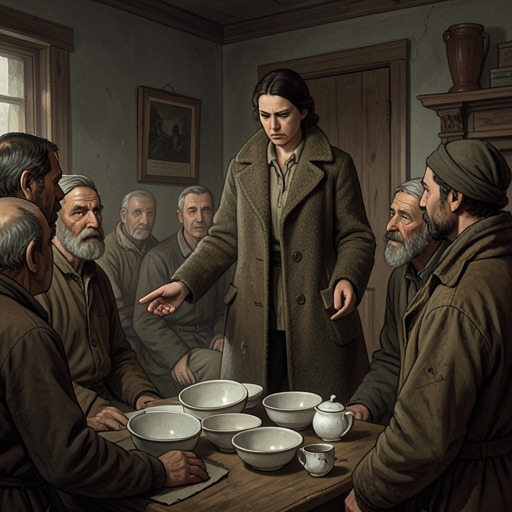
“My daughter has died a virgin”
The House of Bernarda Alba“My daughter has died a virgin” is Bernarda Alba’s repeated declaration after Adela’s death. The phrase makes the family’s public reputation the final concern of the play: rather than acknowledge the truth of Adela’s relationship with Pepe el Romano, Bernarda commands that her daughter be presented as a virgin and that no one speak of what happened.
The declaration at the end
After learning that Adela has died, Bernarda first refuses to enter, then turns to the consequences of Pepe’s escape and issues instructions for handling her daughter’s body. She orders that Adela be taken to her room and dressed as a virgin, repeats that she died a virgin, and says that no one is to tell the truth. The bells, she commands, are to ring twice at daybreak. Her repeated assertion is thus joined to specific acts of staging and public announcement: it is not simply a description of Adela but an attempt to determine how the household and village will understand her death.
The assertion closes a conflict that has become visible within the household, but it does not resolve it. Martirio replies that Adela was fortunate to have enjoyed Pepe, directly contradicting Bernarda’s imposed account. Bernarda answers by forbidding weeping and insisting that grief be kept private. Her final commands return to the play’s repeated demand for silence, now coupled with the instruction that the sisters mourn behind closed doors.
Honour, reputation, and concealment
The play’s commentary connects Bernarda’s declaration to a social code in which sexual conduct is bound to family honour and public perception. Bernarda fears gossip about her daughters and, at the end, insists that the villagers be told Adela died a virgin. The phrase protects the family’s name only by suppressing the truth of Adela’s life and death; it exposes the distance between respectable appearances and private reality.
This concern is not confined to the final scene. Earlier, Bernarda criticizes the Servant over the house’s appearance to mourners and warns her daughters against being overheard arguing because neighbours listen at the walls. The same anxiety about what others might see or say culminates in her attempt to dictate the story of Adela’s death. In the play’s account, reputation sustains Bernarda’s hypocrisy and cruelty, while leaving little room for compassion.
Social context and dramatic significance
The commentary places this honour code within a wider history of gendered violence, while distinguishing social attitudes from the particular events of the play. It notes that Spain’s Penal Code of 1870 permitted a husband to cleanse his honour with blood in specified cases involving adultery or rape, and that this provision was not repealed until 1963. The play does not reproduce those precise legal circumstances; rather, the comparison underscores the severity of the traditional mentality Bernarda shares and the social environment in which female sexual reputation carries such weight.
The phrase’s force also lies in its form as a repeated public declaration. Bernarda does not merely ask the family to remain silent: she supplies the account to be repeated, orders how Adela is to be presented, and prohibits mourning in public. The final insistence that Adela died a virgin therefore binds family honour to enforced silence. It makes the household’s last response to loss an act of concealment, preserving appearances at the cost of acknowledging the truth.